Property Lawyer in Spain
Our team of lawyers can help you buy a property in Spain. We invite you to address to our real estate lawyers in Spain for legal representation.
Our property lawyers in Spain can help both investors and natural persons with in-depth assistance on the legislation regulating the purchase of a local property, on the due diligence procedures, as well as on the provisions that must be included in any purchase contract. For further information on this subject, you can always send your inquiries to our law firm in Spain.
| Quick Facts | |
|---|---|
| Types of properties foreigners can purchase | Foreigners can buy residential properties, commercial properties and land. |
Mandatory legal representation (yes/no) | No, foreigners are not legally required to be represented by property lawyers in Spain, but it is highly advisable. |
Main legal responsibilities of property lawyers | – assist in preparing the documents for the sale, – draw the sale-purchase contract, – verify if the property has any flaws, debts, etc., – assist in paying taxes, – register the new ownership, – help foreigners in obtaining a NIE number (Número de Identidad de Extranjero), etc. |
| Due diligence services offered | Yes |
| Documents necessary for the property purchase | The buyer must provide: – a valid passport, – the NIE number issued in Spain, – the power of attorney – necessary if our property lawyers in Spain will represent the client in various procedures, – a bank extract showing that the foreigner has the necessary capital to buy the property, – a valid visa (where applicable), – passport-sized photos. |
| Main property taxes and fees | – 10% VAT – applicable only for the sale of new properties, sold for the first time, – the transfer tax (charged at rates of 6-10%), – title deed tax, – notary fees, – land registration fee (all charged at rates from 1% to 2.5%), – legal fees charged by property lawyers in Spain (ranging from 1% to 2% from the value of the property). |
| Parties involved in the sale/purchase of a property | – the seller, – the buyer, – the notary, – the lawyers |
| Fees charged by notaries/lawyers (if applicable) | The fees range based on the notary/law firm of choice as well as the services offered (notaries can charge from 0.1% to 1% and lawyers from 1% calculated from the sale value of the property). |
| Law regulating property and property sales in Spain | – Ley de Propiedad Horizontal, the Mortgage Law (Ley Hipotecaria), – La Ley de Arrendamientos Urbanos, – the Civil Code, – the Spanish Property Law |
| Conditions to purchase for EU nationals | EU nationals can easily purchase properties in Spain, but they must apply for a temporary or permanent NIE number, depending on their residency situation (living in Spain or elsewhere). |
| Conditions to purchase for non-EU nationals | Non-EU nationals can also buy properties, and they will have to obtain a non-resident NIE or a resident NIE for this procedure. Visa requirements must also be observed. |
| Documents necessary for the purchase of commercial/industrial property | Foreign investors must obtain a NIE, provide their passport, open a local bank account, provide details on their company (incorporation documents, objects of activity, certificates, information on the available capital to be invested, etc.) |
| Institutions involved in the registration of new ownership | Land Register |
| The mandatory provisions of a property sale contract | – a clear description of the property, – the sale price, – the deadline to pay the required sum, – the terms and conditions to be respected by the seller and the buyer, – identification details of the parties, – the initial deposit, etc. |
| Types of property contracts to sign in Spain | – temporary contracts, – final contracts, – private contracts, – public contracts |
| Steps of the process of buying property in Spain | – property search, – conduct due diligence, – settle purchase price, – sign preliminary contract, – pay deposit (if applicable), – sign purchase agreement, – register property at the Spanish Land Registry, – pay associated taxes |
Land classification | – urban land (suelo urbano), – land for development (suelo urbanizable), – land not for development (suelo no urbanizable). |
Local bank account | Recommended for managing financial transactions and mandatory for applying for mortgages. |
| Content of Land Registry Extract | – details about who owns the property; – any legal issues or debts related to the property; – the property's location |
| How to identify properties in Spain | – name of the municipality, – Land Registry property number, – Código Registral Único (CRU, formerly IDUFIR) number |
| Rehabilitation license | A permission granted by the local Town Hall to a property buyer to carry out the rehabilitation or renovation of an existing structure on a piece of land. Contact our lawyers in Barcelona if you wish to rehabilitate a property in that area. |
| Local regulations | – building height, – architectural style, – construction materials, – environmental restrictions, – cultural heritage preservation, etc. |
| Where to find property for sale in Spain | – real estate websites, – local real estate agents, – social media, – local Land Registry offices in Spain, – newspapers, etc. |
| Setting up utilities | Most urban lands in Spain are connected to water and electricity supplies, but it can vary depending on the location and type of land you are buying in Spain. Our attorneys in Spain can help with the utilities regulations. |
| Property transfer tax | – 6% – 10%, depending on the region. Our Madrid lawyers can help you with the property tax in this specific region. |
| Mortgage options | – variable, – fixed, – mixed |
| Purpose of Spanish Land Registry | To register and maintain records of properties, property deeds, cadaster matters, and other legal documents related to real estate and land in Spain. |
| Activities of Land Registry Office | – record-keeping, – property title registration, – providing property information, – assuring legal certainty in property transactions, etc. |
| Advantages of buying property in Spain | – investment opportunity, – retirement or vacation home, – privacy, – plenty of location choices, – control over property, etc. |
| How can our lawyers in Spain help? | Our property lawyers in Spain can help you buy land in the country by conducting research, negotiating the purchase price, conducting due diligence, drafting documents, obtaining the necessary permits, and more. |
| Deposit requirements on the sale of a property | Usually 10% of the property's sale price |
Penalty clauses | Provided that the seller is unable to sell the property as already agreed, then he/she is liable to paying 20% (twice the value of the deposit) to the buyer. Our property lawyers in Spain can provide more details on other penalty clauses. |
Legal assistance in property disputes (yes/no) | Yes |
| Statute of limitations for property litigation | Maximum 30 years |
| Ways to resolve property litigation | Our property lawyers in Spain can help you in out-of-court procedures, such as mediation and negociation, and they can also provide legal representation in court hearings. |
Why should I book the services of a property lawyer in Spain?
Buying a property in a foreign country can represent, for many, one of the most complex legal procedures. Given the many steps involved, parties, authorities, documents and so on, it is always recommend to address a property lawyer in Spain, who can offer tailored services, including:
- representing clients in finding a property that meets their basic requirements (location, price, etc.);
- drafting the purchase contract;
- participating in negotiation with the seller;
- legal representation in front of the public notary;
- representing clients in any post-sale procedures (new ownership registration, payment of taxes, utilities, etc.).
What are the main due diligence services your lawyers can offer?
It is recommended for a client to get in contact with a property lawyer in Spain for the due diligence process, which includes:
- verifying the identity of the owner;
- the land registry documents;
- the features of the property;
- if there is any mortgage opened on the respective property;
- any debt or legal proceeding,
- any environmental issues.
Is it mandatory to be represented by a property lawyer in Spain?
No, the law does not impose buyers to be represented by a property lawyer in Spain during the purchase formalities, but it is highly recommended to do so, especially as a foreigner who is not accustomed to the legal proceedings applicable in this country. By hiring a specialized lawyer, you can avoid many issues that can arise in the process.
How can I be represented by your team in the process of buying a Spanish property?
All clients, whether they are natural or legal persons, must grant us the power of attorney, the main legal instrument through which a third party (such as our team of lawyers in Spain) can represent any entity in various legal matters. More on this subject is available here:

Who can purchase a property in Spain?
All foreigners have the right to purchase property in Spain (EU/non-EU nationals).
What are the steps I should take into consideration if I want to purchase a property in Spain?
Below you have an overview of the general steps to take when buying a property in Spain:
- market research – the first step is a thorough analysis of the property market and the types of real estate available in the area;
- cultural research – familiarize oneself with the culture and customs of Spain before starting a life there;
- get a NIE (Número de Identidad de Extranjero) – NIE is an identification number for foreigners in Spain;
- find a property – search for the most suitable property for your needs and budget (you can do this with the support of estate agencies or by directly contacting landlords that are looking to sell their property);
- make an offer;
- sign the contract;
- pay the deposit – usually 10-15% of the full price;
- obtain a bank credit/ mortgage – it is important to know that this process can take up to a few months;
- pay the full price agreed with the seller;
- register the property at the Land Registry office.
What are the taxes related to buying real estate in Spain?
During the sale of a property, it is necessary to know that the following property taxes will apply:
- the land registration tax;
- the property transfer tax;
- the value added tax (VAT).
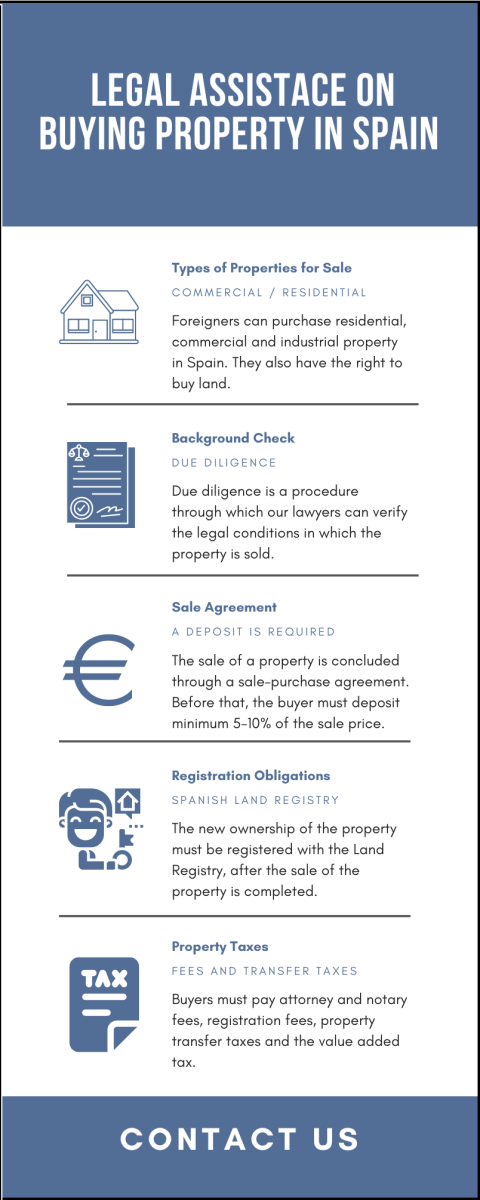
In the infographic below, you can find out how we can offer legal assistance on buying a property in Spain:
What are the elements of a property sale contract in Spain?
If you are interested in signing a sale agreement, you can rely on our property lawyers in Spain for advice on such elements and other provisions that you should be aware of. As a general rule, all contracts should contain the elements that are listed in the section below:
- the object of the agreement – the property that is about to be sold;
- details regarding the seller and the buyer (individuals, companies, identification data, etc.);
- the price at which the property is sold and which will be paid by the new owner;
- the initial deposit that will be offered by the buyer – depending on the contract, the rate can range between 5% to 10% (these rates are generally applied for individual contracts. For contracts where the parties are commercial entities and the object of the sale is a commercial property, the rates are higher);
- information on the property – the square meters, the division of the property (in meters and rooms and information on the land, if the property is a house).
What types of property contracts can one sign in Spain?
When buying/ renting a property in Spain, there are four main types of contracts, that you could choose from:
- Promesa de compraventa (pre-sale contract) – usually this type of contract is used in situations where the property has not been built yet and it is just a project ( It is a type of contract that obliges the seller to finish the construction and the buyer initially has to pay a deposit of 10% and the rest of the sum only after the project is finalized);
- Compraventa (sale contract) – this is the most common type of contract (In this case there is an existing property – the main role of this contract is to transfer the ownership to the buyer and to oblige him to pay the agreed sum of money; there are also some annexes: Property Registry Extract, Energy Performance Certificate etc.);
- Alquiler con opción a compra (rent-to-buy contract) – this is a renting contract that comes with an extra option (it offers the tenant the possibility to buy the property later in the future – this is a good option for buyers who cannot afford to buy a property through a classic sale contract);
- Arrendamiento (rental contract) – this contract contains all the information of the usual rental contract (It is signed by a landlord and tenant and it is used to rent a property for a determined period of time, with a monthly payment).
What are the most expensive cities in Spain?
The most expensive cities in Spain, when it comes to property purchase/ rental, are the country’s most popular /largest cities, such as:
- Madrid;
- Barcelona;
- Malaga;
- Bilbao;
- Valencia;
- Seville;
- Alicante.
Prices vary greatly based on the type of property, whether the property is located in the city or in the outskirts, the city itself, and they range from EUR 1,500 per square meter to more than EUR 7,000.
What are the cheapest locations in Spain?
Usually, small towns, rural places or remote locations. Some of the cheapest options are in: Ciudad Real, Toledo, Cordoba, Almeria, etc., where a square meter costs below EUR 500. Castille-La Mancha is the cheapest autonomous region, where a square meter is valued at less than EUR 350.
Buying property in Spain as a foreigner for investment purposes or for your personal plans is still an important decision and it is recommended that you consult one of our Spanish lawyers for further details. Our lawyers can also help you start an LLC in Spain in approx. 5 weeks, with a share capital starting from EUR 1.
Laura Fusté, Attorney at Law · 2 October 2026