Open a Business in Spain
The first steps to open a business in Spain: choosing a legal structure and registering with the authorities. Our lawyers guide you through the process.

The first steps you need to consider if you want to open a business in Spain involve choosing a suitable legal structure and registering your business with the appropriate government authorities. Our lawyers in Spain can help you select the right structure for your business needs, explain the registration procedure, and handle all the required documentation.
| Quick Facts | |
|---|---|
| Main types of Spanish companies/structures | – limited liability company (SL), – stock corporation (SA) , – jointly owned company (CB), – partnership, – cooperative, – sole proprietorship |
Foreign entities in Spain | – branches, – subsidiaries, – representative offices |
Minimum share capital to open a company | – EUR 1 for SL (special reserve and founder-liability rules apply until the capital reaches EUR 3,000), – EUR 60,000 for SA |
| Bank account required for share capital (YES/NO) | YES |
| General steps to open a company | – select the company type, – obtain tax identification number (NIE), – register with the Mercantile Registry (RMC), – obtain the company tax identification number (NIF, formerly called CIF), – prepare documentation, etc. |
| General required documents | – deed of incorporation, – identification documents of the shareholders, – tax identification number (NIE), – proof of deposited capital, etc. |
| Special licenses and permits | Required for specific industries (healthcare, transportation, finance, hospitality, etc.) |
| Corporate income tax rate | – 25% (standard), – 15% for newly created companies (first profitable period and the next one); in 2026, 23% for SMEs and 19%/21% for companies with a turnover below EUR 1 million |
| Personal income tax for sole traders | From 19% to 47%, based on earned income |
| VAT Registration | Mandatory for all legal entities selling taxable goods/services in Spain. |
| VAT rates | – 21% (standard); – 10%, 4% (reduced) |
| Minimum shareholders required | 1 for both SL and SA |
| Virtual office possibility (YES/NO) | YES |
| Residency requirement | Not required for shareholders or directors of an SL/SA; foreigners need the appropriate visa or permit only to live or work in Spain (e.g. as sole traders). |
| Assistance by our law firm in Spain | Our lawyers will help you select the suitable legal entity type for your business and assist in the entire incorporation process. |
We invite you to watch a video about starting a business in Spain:

What are the main legal structures for starting a business in Spain in 2026?
Here are the main types of legal entities in Spain, as detailed by our Spanish lawyers:
- sole proprietorship, which implies a straightforward process and makes you personally liable for business-related financial risks;
- limited liability company (SL), suitable for businesses with few partners and requiring a share capital of at least EUR 1 (since Law 18/2022);
- newly created limited liability company (SLNE), abolished by Law 18/2022 (existing SLNEs now operate as ordinary SLs, which can also be formed quickly online);
- stock corporation (SA), which can be (but does not have to be) listed on a stock exchange, requiring a share capital of minimum EUR 60,000;
- jointly owned company (CB), where partners work together and share full liability for the business and any debts incurred;
- cooperative (S. Coop), owned by members and operating for their mutual benefit;
- general partnership, which is similar to CB;
- limited partnership, where at least one general partner has unlimited liability and the limited partners’ liability is limited to their contribution.
How can I expand a foreign company on the Spanish market?
Foreign companies have the possibility of setting up 3 different types of structures, as reflected below:
- the branch office (more about this topic is available here);
- the representative office (set up for non-commercial purposes);
- the subsidiary (it is incorporated under one of the legal entities we have mentioned in the section above, where we have presented a detailed list of the business forms regulated by the local law).
What are the main steps I should follow in order to open a business in Spain?
In general, these are the steps you need to follow to start a business here:
- foreign citizens must first obtain a Tax Identification Number (NIE);
- register their company name with the Mercantile Registry (RMC);
- obtain the Company Tax Identification Number (NIF, formerly called CIF);
- open a business bank account;
- sign the Deed of Incorporation, which officially establishes the company;
- register the company and submit the required paperwork to the Mercantile Registry;
- register with the Social Security System, if your business has employees.
What is the most common way to open a business in Spain?
Businessmen usually prefer to set up a business in Spain by registering a limited liability company, because this business form is designed for small and medium sized companies, and it offers investors limited liability against company debts, limited to their capital participation.
What are some of the requirements if I want to register a limited liability company in 2026?
The Spanish SL must respect a few important requirements we present below, mentioning that at least one shareholder is needed for incorporation:
- EUR 1 (since Law 18/2022) is the minimum share capital required to register an SL in Spain;
- one must open a bank account in Spain to deposit the minimum share capital;
- the Articles of Association represent the main documents of an SL in Spain and must be signed in front of a public notary and reviewed by specialized parties, such as our Spanish lawyers;
- registration for taxation and social contributions is required when starting a business as a foreigner in Spain – a tax identification number will be assigned at the end of this phase.
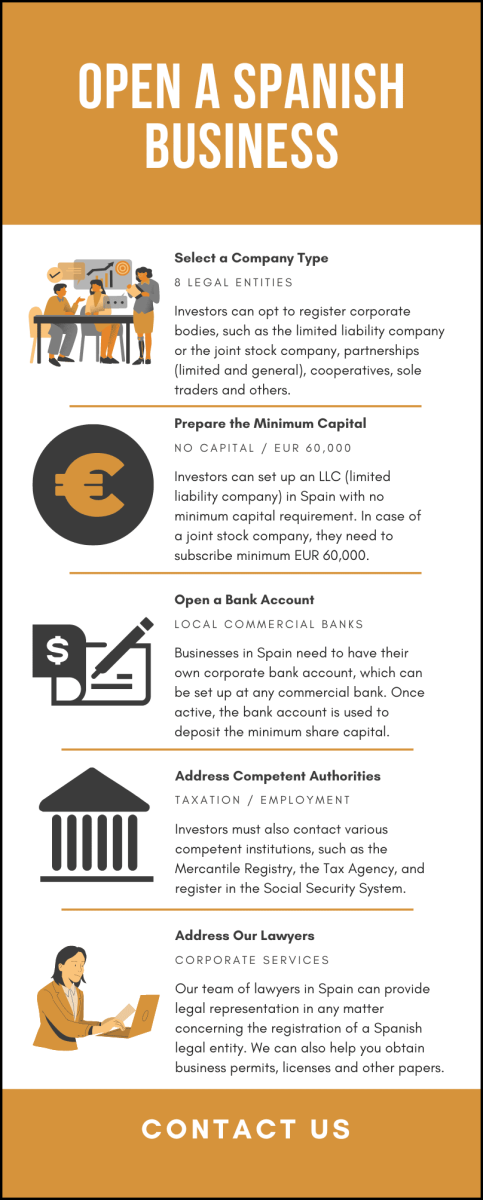
The infographic below presents the basic steps investors must follow if they want to open a Spanish business in 2026:
Can I fully own a company in Spain as a foreign investor?
Yes. Foreign businessmen have the right to own 100% of the shares of a company they have incorporated in Spain. Limitations can appear in certain sectors. Our lawyers in Spain can present the sectors that are included in this category.
Do I need to abide by any residency obligations?
Foreign businessmen are not required to obtain Spanish residency in order to set up a business registered as private or public limited company. On the other hand, those who plan to register as sole traders will need to comply with more complex requirements – such as having a residency and/or work permit.
What is the duration of the incorporation process in 2026?
It can take around 5 to 7 weeks to start a business in Spain, depending on the type of company you want to register.
What are the costs associated with opening a business in Spain in 2026?
In the list below, our lawyers in Spain present the main costs that you should take into consideration when starting a local company:
- virtual office services – basic virtual office services cost minimum EUR 25/month;
- standard company registration – EUR 425 in total registration costs (notary, registry and related fees; there is no single government fee);
- expedite company registration – total costs are around EUR 600 in this case;
- accounting services – these are necessary for any legal entity once it becomes an active business form and they can cost minimum EUR 150/month for small businesses;
- legal fees – the cost is around EUR 3,900.
What other services can I receive in Spain?
Purchasing a shelf company in Spain is also available for foreigners who want to start a business in this country. More about business in Spain for foreigners can be discussed with our company formation specialists in Spain.
If you need assistance in opening a company in Spain, please contact our team.
Laura Fusté, Attorney at Law · 9 October 2026